ONLINE PRODUCTIVITY TRAINING · 3 SESSIONS· 12 HOURS
Stop managing tasks.
Start making space
to think.
A practical performance training in “Sorting Things Out” — extended with behavioral science, habit formation research, and techniques tested in daily-life/work. Built by a practitioner who uses it for 12 years, and teaches it for 7 years.
Who is this training for?
Training context:
The productivity training offered here is a good start for anyone who wants to improve own performance, and create coherent and structured approach to manage tasks.
Every technique that will be presented to you has been tested by your trainer for prolonged period to verify it’s efficiency. It’s presented only because it works in the real life.
If you are interested to find out:
- How the brain chemistry influences our behaviour and how we can manage it.
- How to create a system to organize our own tasks.
- How to direct our attention to help planning own week.
- How to create long lasting habits using simple and tested methods.
This training is for you!
Target audience:
Join us if you are willing to pause what you are doing for a moment and review if HOW you are doing things can be upgraded to another level.
The training is particularly beneficial if you belong on one of the following groups:
- Analyst.
- Consultant.
- Developer.
- Knowledge worker.
- Manager.
- Office worker.
- Product owner.
If you belong to none of the groups above, this training will still bring value to you: the method behind it is universal and can be applied in any environment.
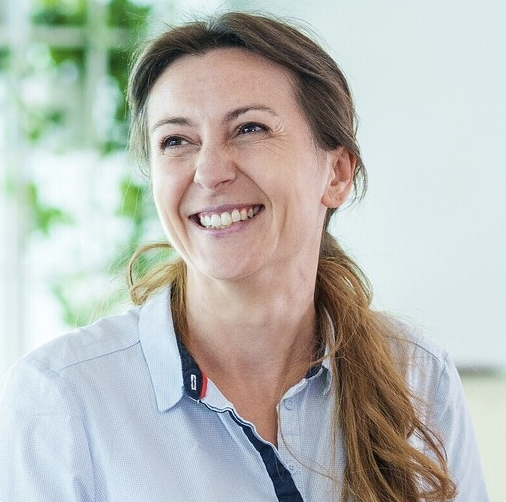
- Trainer of productivity/performance improvement methodologies & the course developer, since ’19.
- Business Analyst & Requirements Engineer, since ’18.
- Product Owner, between ’16 and ’18.
- Working in the IT industry since 2011.
Your TRAINER
Hi, I’m Anna Fic-Oczkos
I came across a first productivity training (called GTD) in 2018 and quickly realized that lots of the techniques presented there I already utilized in my daily work — I’d developed them over the years out of the necessity of managing complex projects, multiple stakeholders, and a constant stream of incoming work.
What I learned through the years is that most people believe they need more time, better tools, or more discipline. In reality, the issue is simpler and more fundamental: the brain was never designed to manage the volume and variety of inputs that modern work demands.
Thanks to my 15 years of expertise working in IT industry, I was able to develop a training that is structured to help others gaining understanding on how to handle the modern workload and get rid of the the mind clutter by structuring and automating the decision making process. During the three days of training we will:
Click here to read further…
- Explore the functional systems of brain and how it works.
- Understand the science behind the placebo and nocebo effect and discover why the mindset plays the crucial role in our day-to-day tasks.
- Learn how to break-down / priorities our tasks and how to remind ourselves about them when the time is right.
- Dive into the importance of paying attention and how it impacts our environment
- Learn how to plan our day / week to make the progress in our tasks noticeable.
- Learn how to set boundaries.
- Dive into the science behind habit formation and learn simple steps on how to form a new habit.
- Explore the flow state and how to reach it.
Across three sessions, you’ll learn not just the mechanics of a productivity system, but the psychology behind focus, stress, and habit formation — so the system actually sticks.
“Your intelligence is not fixed as a shoe size, you can grow it through your own studies and discipline.”
— JIM KWIK, “Limitless”
Throughout, the course draws on research and voices beyond the productivity techniques — from Daniel Kahneman’s fast/slow thinking to Carol Dweck’s work on praise and motivation, Andrew Huberman on effort, and the Fogg Behavior Model on habit formation — grounding a practical productivity system in real behavioural scie
Everything in this course is something that I learned through the daily practice of managing a mid-scale project (6 teams, ~65 people), I trained those techniques during my work and I now want to share them now with a brother audience.

What You’ll Learn in This Course
3 sessions. 1 reliable system.
Each session builds on the last. You leave every session with something concrete to implement that same day.
“I was able to put the concepts into practice immediately, and they have greatly improved the way I organize my work and responsibilities.”
— JoséRamón A.
The techniques she [Anna] shared were clear, practical, and completely new to me, with really well-structured exercises.
— Tommaso R.
System 1 vs System 2
Why your brain is the wrong place to store your tasks
We start with the science: how the brain (System 1 and System 2) work … click to read further
why a worried mind struggles to be creative or strategic and what “wide open space” actually means for productivity. Then we introduce the GTD framework and walk through the first two steps of the five-step workflow.
working memory limit
Making it stick — habits, flow, and daily design
Tools and techniques don’t work without the habits that activate them … click to read further
We cover the Pomodoro technique, flow states, the Fogg Behaviour Model for building routines, and how to design your working day from start to finish. Includes the Natural Planning Model for projects and meetings.
stress and cortisol
Building your system — and keeping it current
Organize everything you’ve captured into a system you actually trust … click to read further
Understand how to prioritize across five attention altitudes — from today’s next actions to your five-year vision. Learn the Weekly Review: the single most important habit that holds the whole system together.
rest and creativity
Final Challenge & Next Steps
- Complete a beginner-friendly final challenge
- Weekly review of your progress for the next month
- Tips for continuing to learn after finishing the course
Research behind every technique.
WORKING MEMORY
The brain can hold about 4 things simultaneously. Forcing it to also track open commitments degrades both memory and decision quality.
Nelson Cowan,
“The magical number 4 in short-term memory”.
DECISION FATIGUES
The prefrontal cortex — just 5% of brain space — uses ~25% of total energy. Reducing decisions through automation directly frees cognitive capacity.
Dr. David Rock,
“Your Brain at Work”.
PRIMACY & RECENCY
Taking structured breaks creates more “beginnings” and “endings” in your learning — dramatically improving retention of what you study.
Hermann Ebbinghaus,
“On Memory”.
FOCUS RECOVERY
After an interruption, it takes an average of 23 minutes to regain full focus. Batching similar tasks and protecting deep work time is measurably better.
Dr. Gloria Mark, “The Cost of Interrupted Work: More Speed and Stress“
NEUROPLASTICITY
The brain rewires itself through repetition. Small, consistent habits build new neural pathways — which is exactly what the course challenges you to create over 3 weeks.
Donald Hebb, proven by experiments in 1970 and ’80
MINDSET EFFECTS
Positive vs negative self-talk changes which neurochemicals your brain releases. Serotonin vs cortisol. The course includes techniques to shift this deliberately.
Dr. Andrew Newberg and Mark Robert Waldman,
“Words Can Change Your Brain.”

If you struggle with one of the following:
- You’ve issues with structuring/organizing your work.
- You feel overwhelmed with the number of tasks at your plate right now.
- You’ve the feeling of not really finishing anything despite working very hard.
- You feel constantly “chased” by everyone around you and you cannot catch a breath.
This training is perfect for you!
Frequently Asked Questions
Do I need to have read the GTD book first?
No. The course is self-contained and assumes no prior knowledge. If you have read the book, you’ll find the course goes considerably further — especially in the areas of behavioural science, habit design, and practical daily routines.
What tools or apps do I need?
None in particular. The principles work with any task manager — Todoist, Asana, Notion, Google Keep, a paper notebook. You’ll see demos of several options, but the course is deliberately tool-agnostic.
Is this suitable for people who already use some kind of system?
Yes — in fact, many participants already have some system in place. The course helps you identify where it’s incomplete, why it sometimes breaks down, and how to make it robust enough to trust under pressure.
How long until I see results?
Many participants notice a difference after the first session — simply doing a full “mind sweep” and processing it to zero creates an immediate sense of relief. The deeper habits take the 3 weeks of the post-course challenge to bed in properly.